
By Dr. Gil Dekel.
Download empty Template of the method.
How does it work?
1. Focus on what interests you (learn to ‘listen to yourself’). Words will then 'come up' to you.
2. Complete the template table with the words.
3. Use the words to conduct research, write essays, or create artworks.
How to write essays, or come up with ideas for art projects?
All true knowledge exists inside people in the form of intuitive insight, but this insight is ‘unknown’ to the conscious mind because it is in the form of experience and emotions, and not in the form of words. Moreover, since there is so much ‘external’ noise around us in life, many people do not listen to themselves. The following method utilises the inner knowledge for conducting research and for writing articles, essays, PhD theses, or even developing ideas for art works. The first step is to ‘listen to yourself’ and come up with a topic to research and write about (or to develop into your art work).
Once people are connected to their inner knowledge, the topic that they will come up with will be relevant to them – it will be what interests them most. By creating categories (key words) people become very specific about their chosen topic – and can use those key words to conduct literature research, which can bring up relevant results. This is useful when facing the vast amount of information, books and articles that is available. No-one can read all the books in the library – so how can we find only the relevant books? And, how can we to cope with the ‘information pollution’ problem where too many irrelevant, redundant, and low-quality articles (mostly online) make it hard for people to find what they are looking for? The answer is: first listen to yourself and define what interests you; then, search only for the relevant literature.
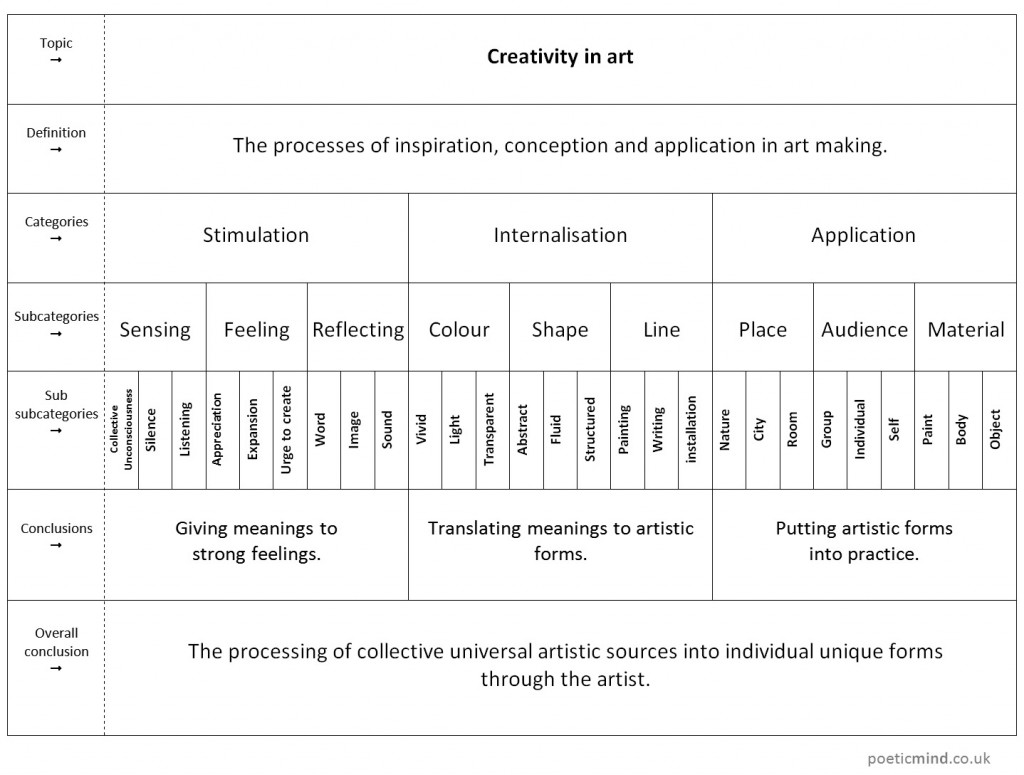
There are seven sections to the template table, which I divide into two:
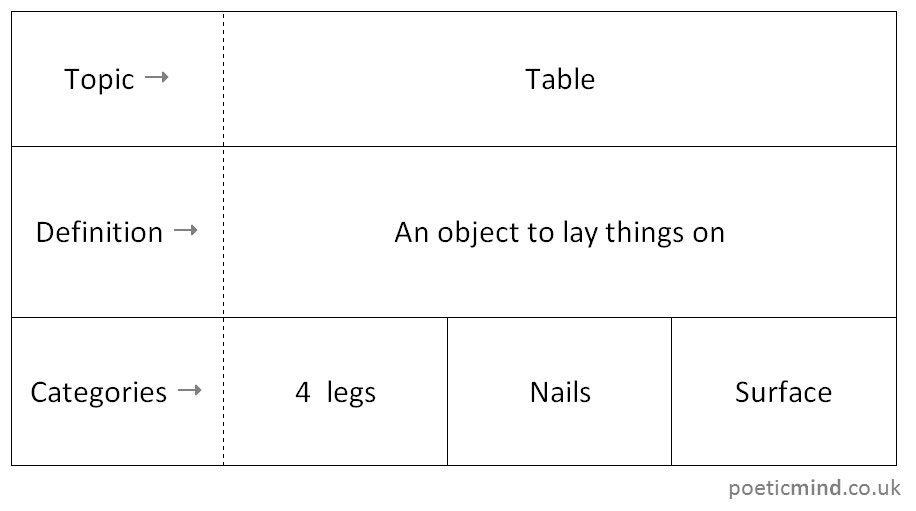
- The first 3 sections are useful for writing short essays or creating artworks (I call it: ‘Words into Objects’ process).
- The total 7 sections are useful for writing academic articles, or structuring a PhD thesis (I call the 7-steps: 'The Streaming Knowledge Method' (SKM)).
Empty template download, with examples.
First 3-sections of the table. Example for topic ‘table’:
The complete 7-sections table. Example for topic ‘creativity in art':
How to fill the Streaming Knowledge Method template table:
Step 1:
Focus on what interests you (learn to ‘listen to yourself’). Word will then 'come up' to you.
- Fill up section 'Topic' in the template table. You need to come up with a specific topic so you can focus your work. The topic needs to come from you, not from other people. This is why we give students 3 minutes only to come up with the topic. If the answers are immediate then they come from you. On the other hand, if you will have too much time to think things over, you may start considering ‘external’ factors that may influence you, and stop your inward listening.
What to do? Name your topic with one to three words. This is the topic you will write about, or produce your art work.
How to do? Focus on one thing only: ‘what interests me?’ and write it down. Do not think about anyone else or what they suggest. Use any of these knowledge-extraction methods.
Time to spend? Spend 3 minutes or less to decide on the topic.
Step 2:
Complete the other sections of the table with words.
- Definition:
What to do? Define your topic using one line.
How to do? How would you explain the topic to someone who knows nothing about it. Do not use the same words of the topic, but different words.
Time to spend? 3 minutes.
- Three categories:
What to do? Write three categories for your definition.
How to do? Three words that make the ‘ingredients’ of your topic and which derive from the definition.
Time to spend? 3 minutes.
- Three sub-categories:
What to do? For each category, write 3 sub-categories.
How to do? Three words that make the ‘ingredients’ of your categories.
Time to spend? 3 minutes.
- Three sub-sub-categories:
What to do? For each sub-category write three sub-sub-categories.
How to do? Three words that make the ‘ingredients’ of each sub-category
Time to spend? 3 minutes.
- Conclusions:
What to do? Write a conclusion for each category.
How to do? Read each of the nine sub-sub-categories, and see what links them together.
Time to spend? 3 minutes.
- Overall conclusion:
What to do? Write overall conclusion in one short sentence.
How to do? Read the three conclusions and see what links them together.
Time to spend? 3 minutes.
Once you come up with a topic, you need to define it in one short line. A definition is saying the same thing using different words. This will provide you with a reference point to observe your topic, and see if that really was what you meant to say. Sometimes people say one thing, but they mean something else. A definition of the topic will allow you to compare and reflect. If you notice that your definition refers to something you did not mean, then simply go back and come up with the new topic, and a new definition.
Now, three categories are required. These are the ingredients of the definition. We ask for three categories, not two, because two categories can clash or compete with each other (like Ping-Pong game). The work may end up being 2-dimentional, whereas three categories will create a 3-dimentional work.
For short essays, you can stop here. You will now use your categories as key words to conduct a search for books online and in the library. You need now to read about your topic and use references in your essay.
For art works, you also stop here. You now can start thinking on creating your artefact – which will consists (be made of, or expresses) all the key words you came up with. These are the ‘ingredients’ for your artefact.
If you structure a PhD thesis, then you want to continue and write 3 subcategories, 3 sub-subcategories, conclusions, and overall conclusion. You do this before you start your literature research. These steps are coming from your own intuitive knowledge about what you know and interested in your chosen topic. At this point, your overall conclusion is only an assumption, a hypothesis, as it came from your own knowledge, not from the literature. After you completed these steps, you can go to the library and start your literature research.
Step 3:
Use the words to conduct research, write essays, or create artworks.
Highlight each category using one specific colour (so you need three highlight-pens). You now start your library research using the keywords with the name of your topic, in your search. You will come up with many articles and books. Look for statements from the articles/books which relate to your categories. You do not need to read the full articles/books at this point – only to skim through. When you come across a statement that relates to one of your categories – print it and highlight it using the correct colour. You will end up with many statements, highlighted in the different colours. Organize them in groups by their colour/category.
Next you will start to ‘assemble’ all statements under the categories on the computer, by simply typing them into your document, remembering to note the source reference.
You will have three headings (categories), under each many statements from the literature that you have assembled. These statements are laid one after the other, but they are not connected to each other at this point. The next step will be to start link them, adding your own ideas to connect the statements. This involves a fair amount of creativity, and again – listening to yourself.
I have conduced my PhD in art (both the theory and practice) using this method, and I recommend it.
* The Streaming Knowledge Method (SKM) was developed by Dr. Gil Dekel, following years of experience in helping art & design practitioners and students develop their writing and research skills. The method is the culmination of interdisciplinary study of Carl Jung, Immanuel Kant, Einstein, Rene Descartes, The Romantic Poets, Quantum Physics, Eckhart Tolle, Reiki and Guided Meditations, as well as the following research methods: Auto-Ethnography, Phenomenology, Participant Observation, Grounded Theory, Narrative Interview, and Dr. Amikam Marbach’s ‘The Process of the Academic Thinking’ method.
© Gil Dekel.
7 March 2012. Last update 1 June 2014.
 - Reading with Natalie, book here...